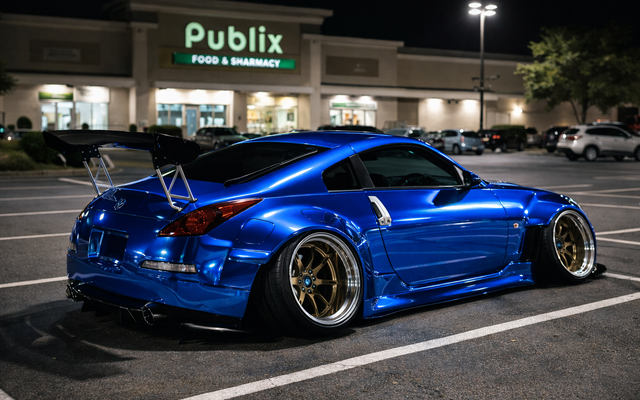
In the high-stakes realm of today's serious sliding, victory is not merely purely a function of brute torque or driver courage. Conversely, it has become a complex engineering challenge that requires a scrupulous fusion of choosing a proven car, equipping it with the highest-quality performance parts, and, most importantly, grasping its real-time characteristics on the track through cutting-edge vehicle dynamics analysis tools. This definitive guide will serve as your master plan from the very first concept of a drift build all the way to the last telemetry-optimized adjustments that elevate a powerful car into a repeatable champion. We will delve deep into the art and science of vehicle alignment optimization, showing how a advanced suspension tuning tool like precise measurement hardware eradicates guesswork and provides unmatched clarity into your vehicle's actual dynamics.
The bedrock of any successful drift car is, without question, the platform itself. Several vehicles have earned iconic standing within the international drifting scene due to their built-in balance, robust design, and the enormous availability of specialist support available. Picking the optimal platform is the first and most important decision a driver will make. For instance, the BMW's E36 3 Series is commonly accepted as perhaps the the greatest balanced drift cars of history. Its almost ideal evenly distributed mass, alongside a rear-wheel-drive configuration and extremely reliable inline-six powerplants, establishes a chassis that is both forgiving for newcomers and highly capable in the control of a pro competitor. The successor of this concept, the BMW E46, builds upon these qualities with a increasingly sophisticated structure, wider stance for greater confidence, and even a greater degree of steering angle straight from the OEM. A different formidable option in the pro arena is the Corvette C6.
This V8-powered sports car introduces a particular set of strengths to the sliding sport, such as a low-mass aluminium structure, a transaxle-style transaxle that helps create an excellent front-to-rear mass ratio, and the immense thrust of a large-displacement GM LS engine. This combination renders it an absolute monster on track, capable of starting and sustaining long angles with seemingly easy deployment of power. For drivers seeking outstanding performance per dollar, the 350Z model Nissan excels as a prime choice. It is delivered from the factory with a rigid platform, a competent original LSD, and the smooth V6 engine that delivers sufficient performance for mastering and progressing in the discipline. Its successor, the Nissan Z34, presents more improvements in body strength, suspension design, and outright motor output, solidifying its place as a popular choice among competitive pilots. Additional historic cars that merit mention are the nimble rotary-powered Mazda FC RX-7, the most popular S13 Silvia/240SX, the torque-rich Ford SN95, the more recent BMW E90, and the compact yet surprisingly fun and forgiving MX-5 Miata. Each of these chassis offers a different palette of traits, challenges, and capabilities, but they all share the basic elements necessary to serve as a serious sliding vehicle.
However, choosing the correct chassis is merely the beginning. To access the complete capability of any of these vehicles, major changes to the steering geometry and damping and springing systems are completely non-negotiable. This is where the world of performance tuning components comes into vital view. The single most transformative upgrade for a serious drift machine is the fitting of a maximum-angle steering angle kit. These engineered systems, like those engineered by performance brands like specialist manufacturers, are engineered to dramatically enhance the car's available turning lock. A factory street car is severely limited in how far its front wheels can pivot, a safety limitation for daily driving. In oversteer driving, conversely, extreme opposite lock is continuously needed to manage and maintain a slide. An steering kit substitutes the stock hubs, tie rods, and sometimes suspension arms with parts that enable the steered wheels to attain steering lock in excess of 70 or even 80 degrees, versus a average stock limit of around 40 to 50 degs.
This vastly expanded capability provides the pilot with significantly more command during a angle, allowing it to be considerably easier to start a oversteer moment, sustain it through a extended bend, and transition smoothly from one angle to the opposite. The difference in controllability is truly revolutionary. Coupled with a appropriately specified angle kit is the every bit as essential upgrade to the chassis's damping system. Off-the-shelf or including high-end sport coilovers are generally not engineered for the particular and harsh needs of sliding. A dedicated pair of coilovers is crucial. These specialized dampers have specific piston tuning and spring stiffness that are tuned for the violent weight transfer that is typical of aggressive driving. When a pilot initiates a drift, the chassis's weight is transferred forcefully to the front of the turn. Correct drift-spec suspension control this transfer in a predictable fashion, enabling the chassis to find its balance rapidly and giving the pilot accurate response through the controls and cockpit. They also allow for precise adjustment of ride height, rebound and compression firmness, and cross-weight, which are all key aspects of dialing in the car's behavior to a particular track or driving style. Together, a high-quality drift angle kit and a properly chosen set of competition suspension units form the undeniable hardware foundation upon which all subsequent optimization is based.
Once the core components is fitted, the following critical stage in the development is the detailed adjustment of the car's suspension geometry. This is the world of vehicle alignment optimization, a procedure that can seem daunting to the beginner but is, in fact, the key to turning a assembly of fast pieces into a cohesive and controllable vehicle. The most discussed parameter of suspension geometry for oversteer is certainly camber. Camber angle is the angle of the tire in relation to the vertical line when viewed from the front-on of the vehicle. If the top edge of the tire is angled towards the chassis, this is referred to as inward tilt. In oversteer driving, inward-leaning wheels on the steering tires is generally used and is regarded as necessary. The logic is intrinsically tied to vehicle dynamics.
When a chassis is cornering at high angles, the body tilts to the outer of the turn. This body roll causes the outer front tire to reduce its optimal footprint with the track surface. By adding an inward tilt, the tire is pre-angled to counteract this tilt. As the car leans into the turn, the outside front tire gains a better contact patch against the road surface, maximizing its bite at the critical point when it is absolutely essential for steering authority. Typically, front axle angles for a dedicated drift car range from approximately -3 degrees to as high as -5 degrees or even greater, based on the parameters of the car geometry, compound type, and pilot style. The rear wheels also utilize negative camber, but the values are generally less and more nuanced than the front. Overly aggressive inward lean at the rear can cause the vehicle to excessively tail-happy and difficult to control on power application, as it reduces the available tire footprint of the powered wheels during linear throttle application. Hence, rear axle adjustments are frequently in the ballpark of -1 degree to -3 degrees, striking a precise equilibrium between giving enough lateral bite to assist in initiating and maintaining the drift while simultaneously maintaining effective hook-up for acceleration the corner. alignment is just one component of the broader suspension geometry puzzle, which furthermore encompasses toe setting, caster angle, and bump steer correction.
Toe setting describes the direction of the wheels as seen from above. Inward toe means the front edges of the wheels are nearer together than the rear edges, while toe-out means the reverse. For sliding, a slight amount of front negative toe is commonly employed to sharpen the initial directional feel, making the vehicle feel more agile and ready to initiate a oversteer moment. Rear axle toe setting is usually set to zero or a incredibly minute amount of positive toe to encourage predictability under acceleration. self-centering is the frontwards or rearward inclination of the kingpin axis when viewed from the lateral of the car. Positive positive caster increases self-centering and high-speed solidity, and it also boosts camber increase during turning, which is extremely advantageous. Setting these values is a complex interaction where a modification to one setting can and often will influence the others. The old-school approach for setting a car's alignment for sliding has historically been a tedious process of guesswork and adjustment. A pilot or crew would make a change based on experience, drive the car on track, depend on the operator's individual perception and comments, and then apply a further change. This process would iterate time after time until the chassis felt "right" or the allotted testing time ran out. This system is not just extremely slow in terms of time and resources, but it is furthermore deeply inaccurate.
Human feel is a famously inconsistent metric, influenced by many factors such as exhaustion, varying track grip levels, ambient heat, and merely the mindset of the operator on that specific day. What feels "oversteery" on one lap might feel "understeery" on the subsequent run, leading to contradictory feedback and counterproductive adjustments. This traditional challenge in chassis setup is precisely where state-of-the-art technology has made its mark to revolutionize the methodology.
The development and adoption of specialized vehicle dynamics tools has introduced a new age for engineering and optimizing professional drift cars. This new generation of tools, showcased by groundbreaking systems like modern telemetry hardware, function by physically measuring the live dynamic movement of the chassis as it is operated on the course. Unlike using subjective feel, these systems acquire quantifiable metrics on key variables such as suspension travel, individual tire rotation, lateral and longitudinal g-forces, suspension engineering wheel angle, and throttle and brake position. This acquired data stream is then analyzed by sophisticated software that can graph and decode the information in a actionable way. For the first time ever, engineers and builders can observe specifically what the vehicle is exhibiting at every point of a drift. This function transforms the whole suspension tuning procedure. Imagine the particular goal of dialing in the front axle negative camber for a particular vehicle. Instead of applying a modification from -3 degrees to -3.5 degrees and then driving several passes to try and "feel" a improvement, a suspension tuning tool can deliver real-time and irrefutable data. The tool can show visually how the suspension's contact patch is performing during the most important stages of a angle: the initial flick, holding the angle, and transition. It can demonstrate if the current camber setting is allowing the outside front tire to keep maximum grip or if the rubber is over-stressed on its outside edge.
The tool can subsequently provide fact-based advice for modification. Perhaps the information reveals that the outside front tire is even stressing its edge at -3.5 degrees of camber, suggesting that even more negative camber, say -4 degrees, might be beneficial. Conversely, the information might reveal that the tread is failing to achieving heat or that the inside edge is degrading excessively, which could indicate that there is excessive inward lean and a small decrease back to -3.2 degrees would be better ideal. This degree of granularity and practical analysis was completely impossible in the time of exclusively seat-of-the-pants adjustment.
The effect of using a advanced suspension tuning tool goes well beyond only setting camber angles. It becomes an essential coilover setup tips that is tailored to your exact car. When adjusting the shock absorber clickers on your suspension, rather than using general tips or copying another driver's numbers, you can employ the software to analyze how the chassis is behaving in relation to your changes. The tool can graph the suspension travel path over a lap, highlighting if the coilovers are handling the chassis motion optimally or if they are causing the car to become unsettled uncontrollably after a transition. It can assist in identifying challenges like excessive compression or topping out, enabling you to apply informed drift telemetry software decisions to spring preload, damping values, or ride height. This approach extends equally to the complex process of suspension geometry optimization. In addition to camber angle, the tool can offer analysis into how adjustments to toe settings and caster angle are affecting the chassis's stability during different phases of a lap. For example, it can help you to ascertain the ideal amount of front axle toe-out for your specific steering rack geometry and competition style by measuring the quickness of turn-in reaction and the stability of the chassis at maximum countersteer. This transforms the system an extremely effective drift suspension tuning guide that is dynamically informed by the actual behavior of your personal vehicle on the circuit. It shifts the whole process from a subjective skill into a methodical engineering exercise.
Furthermore, the value of a vehicle dynamics tool tool like modern telemetry is not at all restricted to expert tuners with extensive funding. For the amateur driver, it acts as an incredible force multiplier. It effectively provides the builder with the insight of a professional race engineer without requiring the associated overhead. It drastically shortens the learning curve by delivering definitive directions to questions that would normally take seasons of trial and error to answer. A tuner can understand how their individual car responds to different settings, building a deeper knowledge of suspension theory in the journey. It furthermore makes accessible high-level suspension engineering techniques, enabling all drivers with the ambition to perfect their machine to achieve it in a structured and productive manner. This is particularly important in a activity like oversteer competition, where engineering knowledge has historically been a tightly held advantage among elite teams. In the modern era, that capability can be in the hands of every serious enthusiast.
In the final analysis, the journey to constructing and dialing in the ultimate high-performance drift machine is a multi-stage mission that seamlessly combines time-honored engineering wisdom with cutting-edge telemetry technology. It commences with the wise pick of a capable car, then enhanced by the installation of non-negotiable drift-spec parts like maximum-angle angle modification systems and correctly valved competition coilovers. The build then advances into the precision realm of chassis dynamics adjustment, where parameters like negative camber, toe, and caster angle are meticulously set to match the car's upgraded geometry and the operator's specific needs. Finally, and what genuinely differentiates the modern methodology from the traditional methods, is the adoption of a powerful vehicle dynamics tool. This tool eliminates the uncertainty and trial and error of solely feel-based tuning by delivering empirical, real-time telemetry on how the chassis is actually behaving. It functions as an incredible suspension tuning tool, a definitive alignment optimization handbook, and a master performance analyzer. As a complete package, this holistic philosophy ensures that each and every component of the drift machine—from the selection of the platform to the most minute click on the suspension—is refined for peak competitiveness on the competition venue. It represents the complete evolution of the art of sliding, connecting mechanical driving skill with surgical suspension engineering to forge the most competitive machines attainable.